
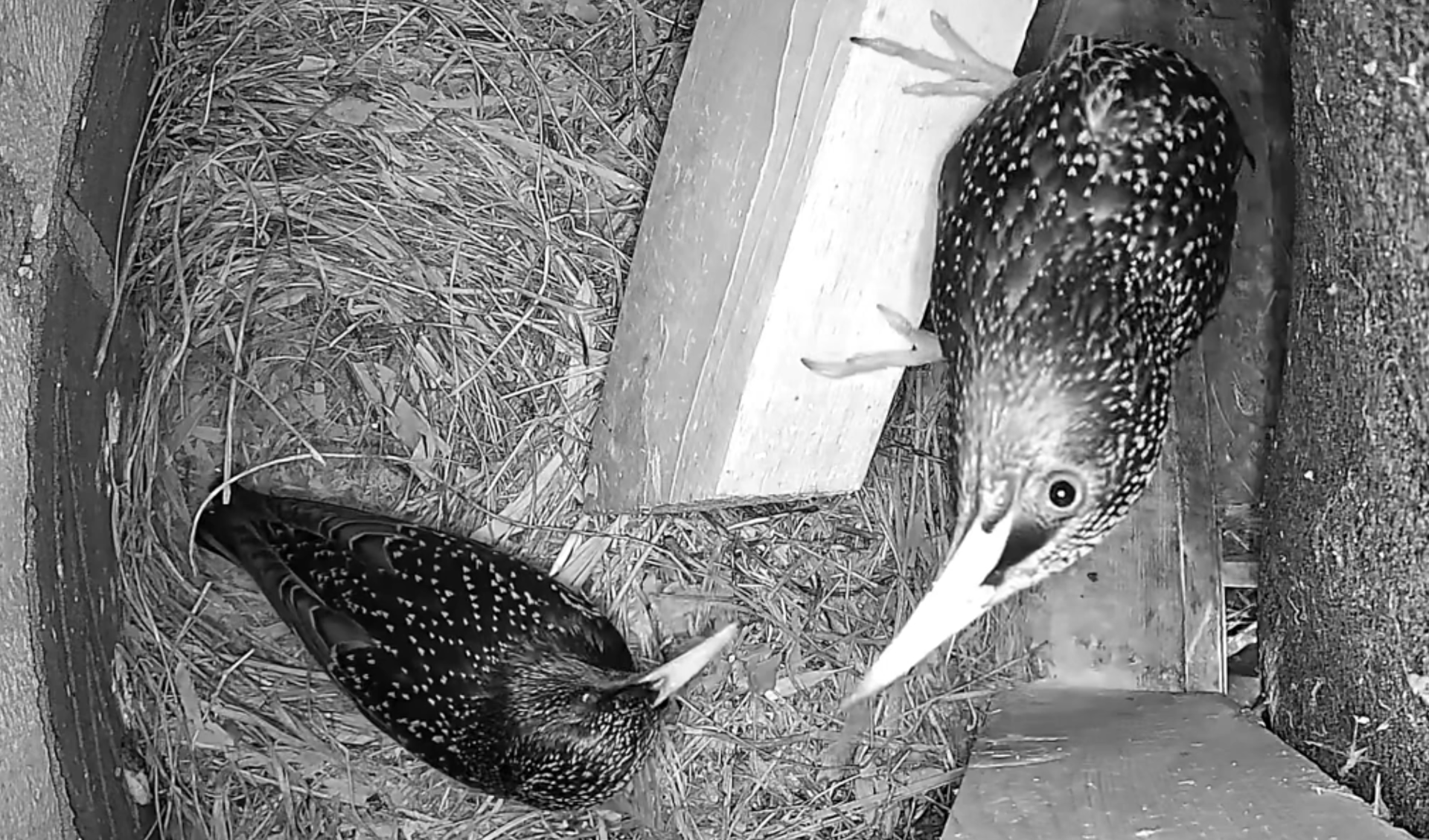
Starling Nest Camera Livestream
This is another aside from the music most of you associate me with. This last week we’ve been watching starling chicks in a nest in our roof and livestreaming the camera feed to Youtube. It’s crazy how much food the parents have gathered and how much they’ve grown in just a week. Somewhere between one and two more weeks and they will be off out into the world.
I’ve set up a YouTube channel – Devon Starling Nest for the feed and for clips of the interesting bits, as and when I can get the time to organise some. Feel free to share and watch the “cheep” entertainment. I’ve had a small window in the corner of my screen (YouTube’s picture in picture pop out player) most of the time I’ve been sat at a computer this last week. Most of the action at the moment is from 6 in the morning until 11 and from 3 until about 7. In between that the chicks do more sleeping (and growing). The mum sits on the nest covering and warming the chicks at night at the moment, though she gave us a bit of a scare on the third night after they’d hatched when she didn’t return all night and the temperature went down to 7 degrees outside. I ended up watching them until far too late at night and steeling myself for seeing a nest of perished chicks in the morning. But amazingly they were all fine on Saturday morning and the parents carried on as if nothing untoward had happened. I’m sure there is more drama to come, with magpie nests nearby.
I’ve spoken to some people surprised that we tolerate the birds nesting up in the roof, but for us, we (humans) have taken enough away from the birds already that it seems churlish to deny them this space, when it causes us so little bother. I guess part of my reason for sharing the livestream and clips is to show how actually, they’re not so different from us as we might think. Any parent watching will know exactly what I mean.
I grew up watching starlings squabbling and feasting on the food left out on the wall between our little garden and the next, and even then their numbers noticeable dropped year by year. By the time I left home (Worcester) we didn’t see them at all. Here in Exmouth we see plenty of them – not in such numbers as there may once have been, but I see groups of fifty or sixty birds flying in the formations for which they are known. Perhaps not large enough to ever be called a murmuration, but definitely presenting a much more difficult target for predators.
How and why?
Each year we’ve been in this house, we’ve heard the starlings nesting, and finally this year my curiosity got the better of me and I got hold of a nest camera and installed it in the loft. Fortunately there was a lighting circuit already up there, so I added a socket (just for low power items), and carefully installed the camera where it had a good view of where they had previously nested. I then had a few technical problems. The supplier was helpful in confirming that the messages in the error log were down to poor wireless connectivity, which wasn’t a complete surprise with the camera being in the roof. Fortunately I was able to turn off the wireless and use a wired connection to an old Powerline adaptor I wasn’t using.
This was back in January, and it was good that I didn’t leave it any later as it turned out the hole was already being visited. I can’t tell if either of the pair of starlings had used the nest space before, but the camera didn’t go unnoticed, even in the dark space. The feed is in black and white as the camera is using infra-red, which doesn’t disturb the birds as they can no more see in infra-red than we can (though they can apparently see further into ultra-violet). The space is very dark, so really they’re doing an amazing job managing (so far) to evenly feed their chicks.
I was sharing clips with family but realised the ideal thing would be to have a live feed that anyone could check on… and indeed no need to just keep the feed to friends and family once it was established. To get the thing up and running I needed a spare computer I could keep running, and to enable live streaming on the YouTube account I had set up. You have to identify yourself as a real person, and then apply to enable live streaming, which took 24 hours. I had an old laptop (from 2012 I think) which fortunately has enough grunt to handle converting and streaming a black and white feed at a high enough bitrate to be worthwhile. And I’m using OBS Studio, which is an excellent piece of software for streaming and recording. If you use an older computer like this, it’s a good idea to run it for a while and check it’s managing to keep itself cool enough! I propped mine up on a couple of small pieces of wood to ensure good ventilation, and also played with the bitrate to find a place where the setup had good equilibrium.
In case anyone has read this far thinking this is something they would want to do, I’ll add two cautions. The first I’m sure you’re already aware of if you’re this keen to see into a nest – don’t disturb a nest site in use. In the UK this is illegal, but hopefully it’s obvious that birds can be easily spooked and if they see human activity they can abandon a site with eggs or chicks in. The second is more to do with the cameras themselves. They are certainly amazing little bits of kit, and there seem to be many of similar build – repurposed security cameras. These IP cameras are sometimes running on software intended for a security setup. I don’t like that mine has a web interface that doesn’t even use https… and I wouldn’t be bothered about that except that they are designed to be accessed remotely using peer-to-peer (P2P) technology. Despite being labelled P2P, as I understand it the setup requires contact with a central server run by the manufacturer. The (android) app that you use to most usefully access the recorded video and see where the alarm has been triggered simply doesn’t work if you don’t have the P2P enabled. And if it is enabled, sure enough you can access it away from your local network and it punches through your firewall as though it wasn’t there. Imagine, having sold all these, if you could access all their audio feeds… all the conversations in people’s gardens. Feed it into an AI agent to pick out the snippets of interest. Anyway, conspiracy theories aside, I’m living with it as it is for now.
It is designed to be easy for anyone to set up and use – the app can be set to send push notifications to your device. Or, you can get it to send you an email with a photo attached when the alarm is triggered. (If you do this, I recommend setting up a separate account!)
One other thing I’ve found is that the 8GB card supplied with the camera is far too small if you are recording round the clock and want to go back more than a few hours, you’ll want a much bigger one.